Tesla, Inc. (TSLA) Announced Q1 2026 Earnings on April 22, 2026, Reporting auto margins, excluding credits, improved sequentially from 17.9% to 19.2%
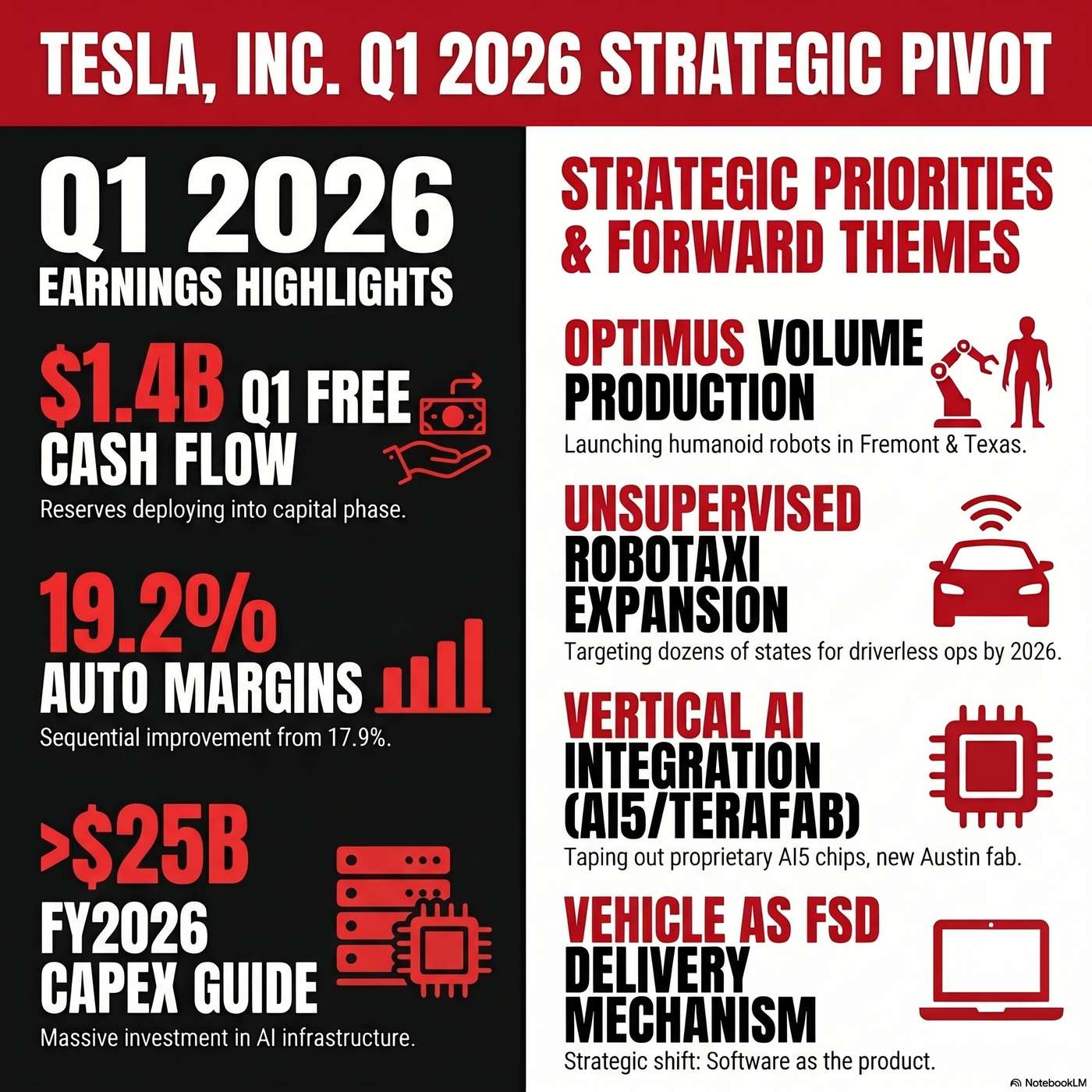
For the first quarter of 2026, Tesla reported it "ended the quarter with just over $1.4 billion" in free cash flow.
Management noted that "auto margins, excluding credits, improved sequentially from 17.9% to 19.2%", which included onetime benefits from "warranty true-downs around $230 million" for the quarter.
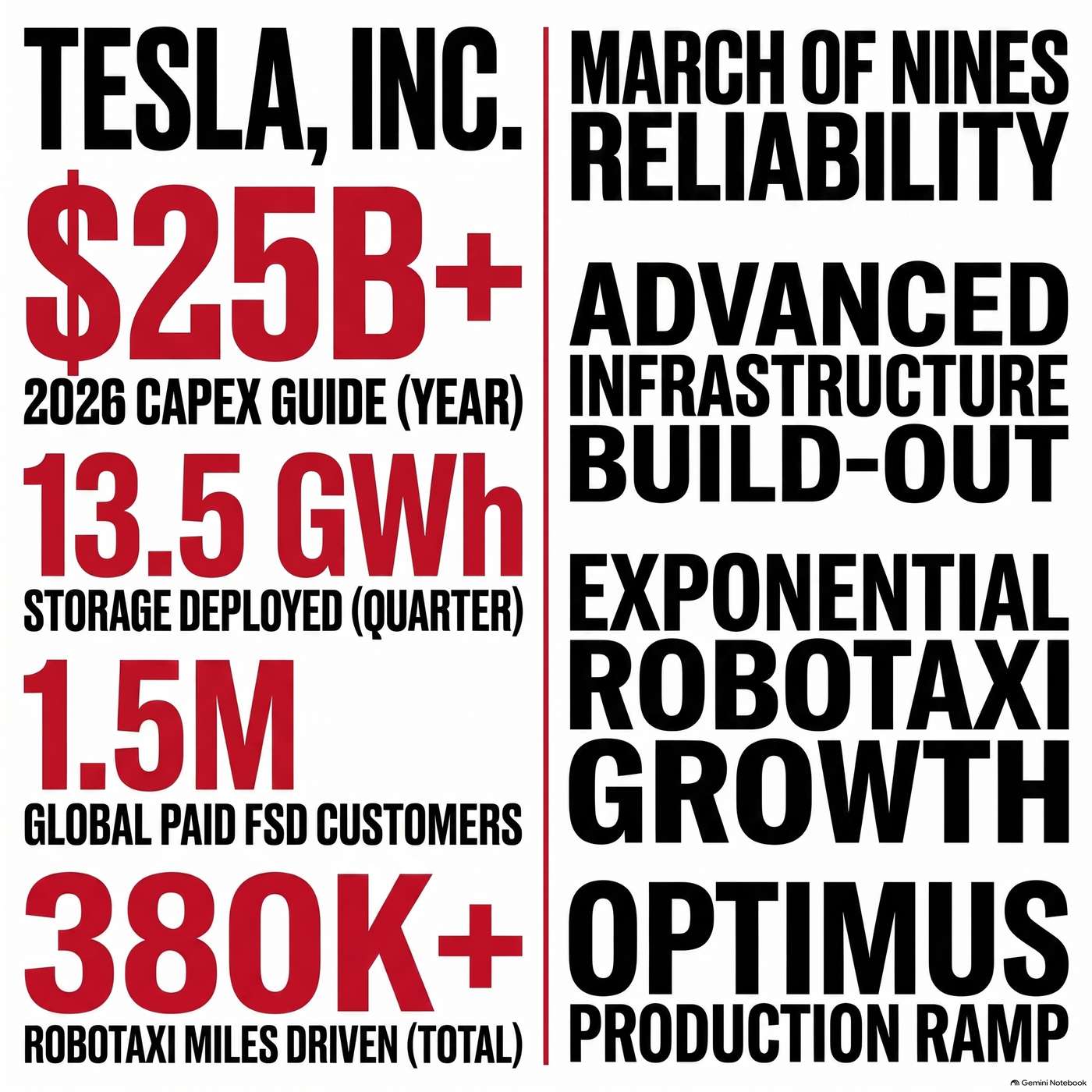
The energy storage business set a record with gross margins "over 39.5%", benefiting from "tariff recognitions of more than $250 million". Regarding future investments, the "current expectation for 2026 is over $25 billion of CapEx" to support six factories, AI infrastructure, and new product launches.
During the call, executives outlined plans to dismantle the Model S and X production line, with the "last S and X production" occurring in "early May". The capacity will be converted for the Optimus robot, with a targeted "start of production" that is "somewhere around the late July, August time frame". Tesla also shared details on its internal semiconductor plans, confirming a "research fab" at Giga Texas. CEO Elon Musk described this as a "$3 billion-ish initiative" that will be "capable of maybe a few thousand wafers per month", adding that Tesla plans "to use Intel's 14A process" for core manufacturing technologies.In the software business, the company reached "nearly 1.3 million paid customers globally" for its Full Self-Driving product.
The Robotaxi fleet has expanded to Dallas and Houston.
While Musk mentioned that unsupervised FSD will reach customer cars "probably in the fourth quarter", he clarified that "hardware 3 simply does not have the capability to achieve unsupervised FSD", necessitating hardware retrofits.
Additionally, management announced the early tape-out of the new AI5 chip, which will be utilized in Optimus and data centers.
Looking forward, Tesla intends to "keep growing volumes further" across all vehicle factories, though executives cautioned that their "biggest limiter continues to be our battery pack capacity". For energy storage, the company deployed "8.8 gigawatt hour of energy storage" in the first quarter.
Despite this being a "38% sequential decline", management stated they "still expect 2026 deployments to be higher than 2025" for the year and are preparing to "begin production of Megapack 3 later this year".
Related Episodes