Uber Technologies, Inc. (UBER) Announced Q2 2026 Earnings on August 5, 2026, Reporting "non-GAAP EPS growing 35% year-over-year"
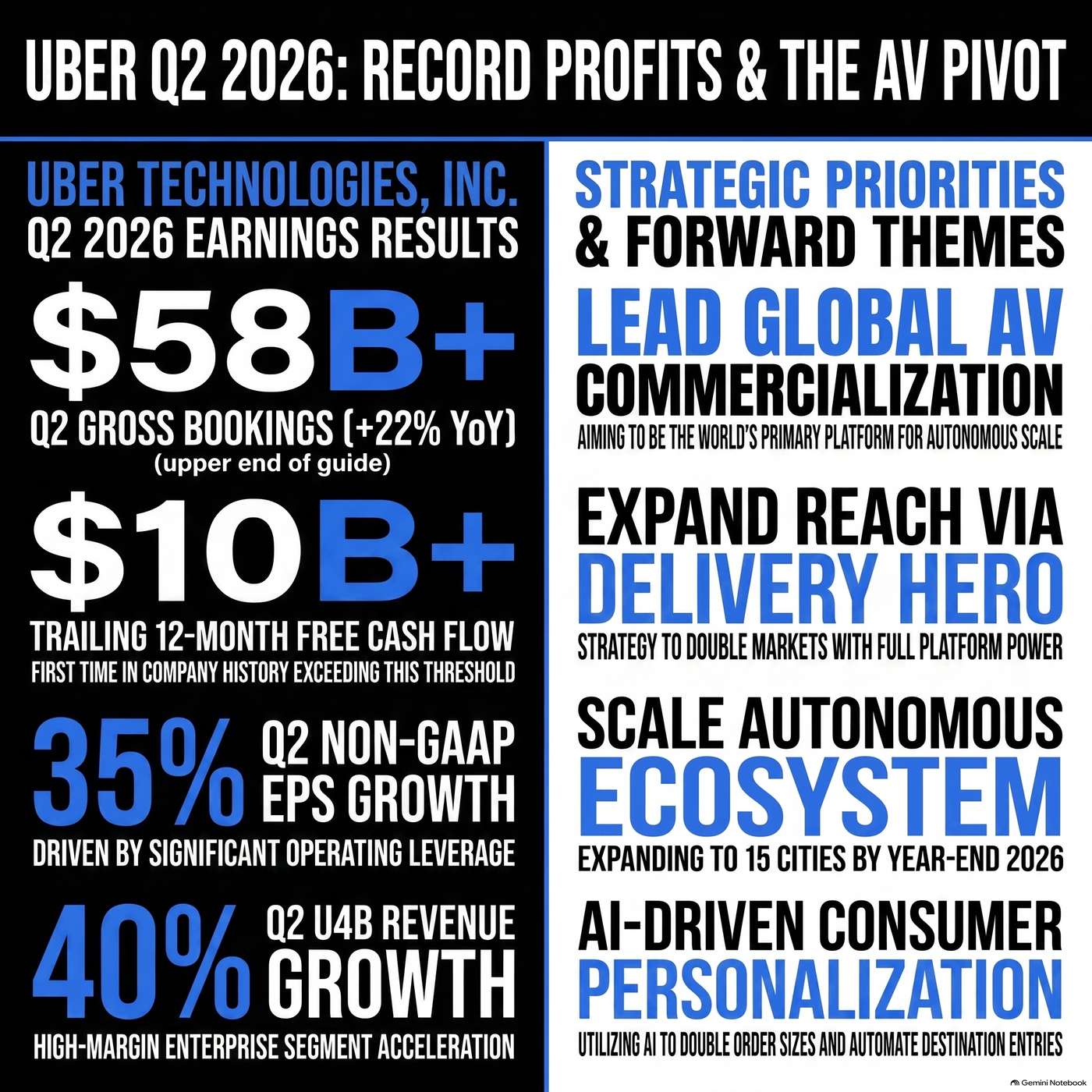
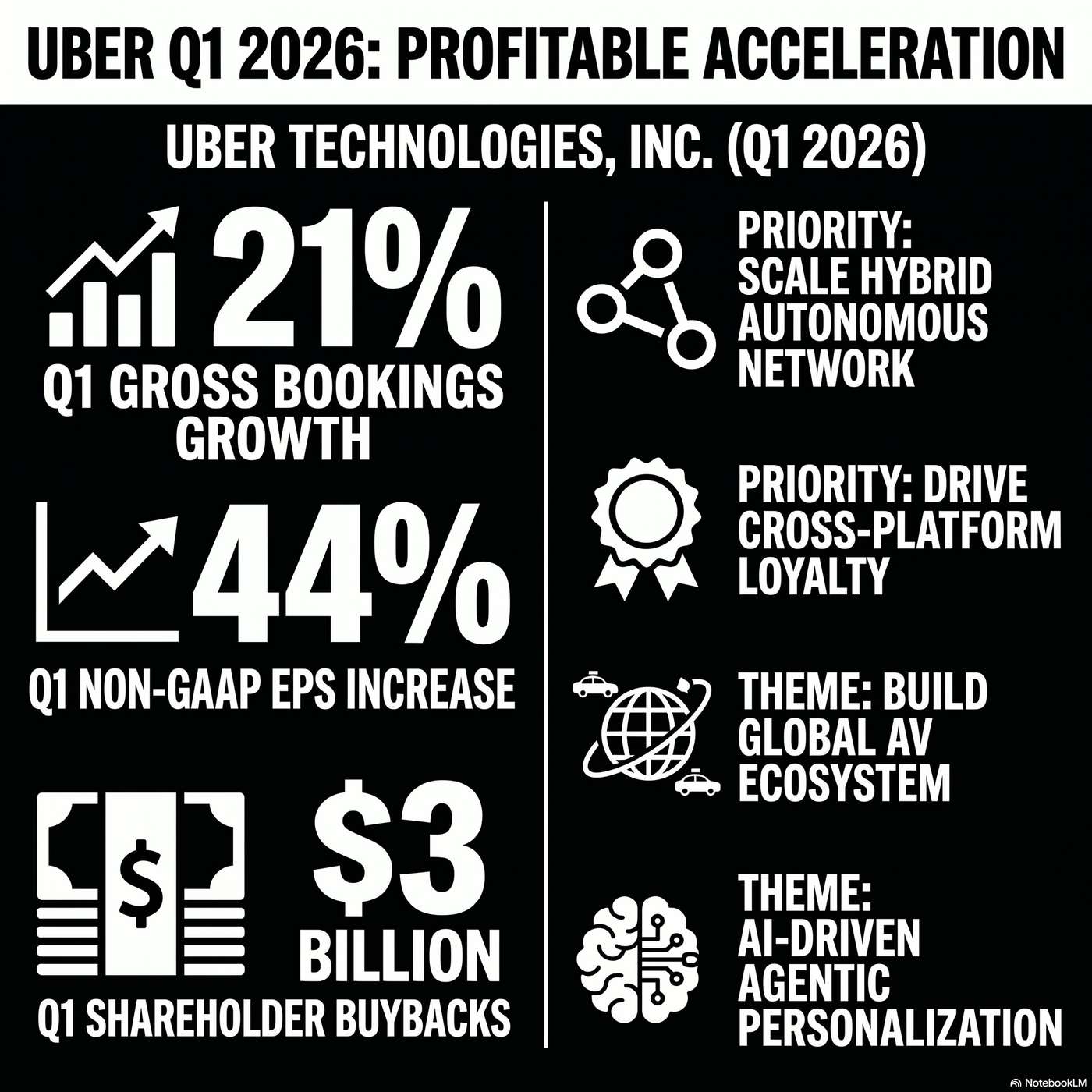
Uber Technologies, Inc. reported that for the second quarter of 2026, gross bookings grew 22% year-on-year to more than $58 billion, marking the company's fourth consecutive quarter above 20% growth. CEO Dara Khosrowshahi announced that non-GAAP EPS grew 35% year-over-year, and trailing 12-month free cash flow exceeded $10 billion for the first time in the company's history. CFO Balaji Krishnamurthy noted that the mobility operating income margin remained strong at 7.6% for the quarter.
Additionally, Uber bought back about $3.5 billion of its stock during the first half of the year and deployed about $4 billion of capital in the second quarter towards market purchases of Delivery Hero stock.
Management highlighted several key priorities and strategic initiatives, including its recently announced agreement to acquire Delivery Hero, which is expected to expand Uber's reach to nearly 100 markets and double the number of markets where it can offer both mobility and delivery services. On the autonomous vehicle front, the company is aiming to become the world's leading commercialization platform for autonomous vehicles.
Uber is currently live in 7 cities and is on track to be live in 15 cities with autonomous vehicles by the end of the year.
The company is also seeing strong growth in sparse markets and suburbs in the United States, where less than 10% of eligible consumers have used Uber in the past 12 months, compared to over 50% in dense markets.
Furthermore, developer productivity is being accelerated through the near 100% adoption of AI-based coding tools among engineers, resulting in a doubling in the code output per engineer.In terms of future plans and partnerships, Uber plans to spend 2028 on planning and development for the Delivery Hero integration, assuming the transaction closes in the second half of 2027, with primary migrations scheduled for 2029. In autonomous vehicles, Uber announced upcoming launches including Nuro Lucid in the Bay Area, Zoox in Las Vegas, Wayve in London and Tokyo, Baidu in London, and Pony and Verne in Zagreb.
The company also expects to deploy vehicles with Rivian in San Francisco and Miami in 2028.
Uber is selectively using its balance sheet to bootstrap the autonomous vehicle infrastructure, aiming to deliver 120,000 vehicle commitments over the next few years. On the product side, Uber is driving consumer engagement through artificial intelligence features like Cart Builder, which has produced carts often twice the size of non-AI built carts, and personalized destination suggestions, which represent three-quarters of Uber's rides.
Related Episodes